

By David Miguel on May 5, 2026
Quick links
12 marketing automation examples: quick view
The best marketing automations start with a clear trigger, perform a useful action, and move a customer or prospect toward a measurable outcome. Here are 12 practical examples covered in this guide.
You do not need all 12 at once. Start with the workflow closest to a commercial bottleneck, such as slow lead follow-up, abandoned purchases, weak onboarding or poor retention, then build outward from there.
Marketing automation works best when it responds to something meaningful: a new signup, a high-intent page visit, an abandoned purchase, a customer milestone or a period of inactivity. The workflow then handles the next step consistently without requiring somebody to remember it every time.
The examples below cover the full lifecycle, from attracting and nurturing prospects to converting customers, improving retention and creating advocates. They can be adapted to different platforms and business models rather than relying on one specific tool.
If you are still deciding how automation should fit around your sales system, start with CRM vs marketing automation. If the workflows are clear but the platform is not, compare marketing automation platforms or use our framework for choosing the right marketing automation platform.
Why automate your marketing

Marketing automation is not about buying shiny software. It is about building dependable systems that remove waste, reduce guesswork, and improve transparency, productivity, and business outcomes. For teams that want to connect apps and automate operational handoffs, workflow automation with n8n is a useful next layer to understand.
Beyond efficiency
You spend more time than you realize on routine tasks: sending follow-up emails, confirming webinar registrations, nudging sign-ups who never finished a form. Automation takes care of these repeatable tasks at scale. Email sequences, SMS reminders, in-app notifications, and lead handoffs occur without dragging your team away from higher-value work.
For many businesses, that time can be redirected into planning, testing and creative problem solving instead of repetitive campaign administration. Manual work introduces avoidable errors such as wrong segments, outdated lists, missed time zones, or entire campaigns simply forgotten.
Well-designed workflows execute exactly the same way every time, which decreases those errors and safeguards your brand. With a well-configured cart-abandonment journey, every eligible customer receives the intended follow-up rather than relying on somebody to identify and contact them manually.
Automation helps your team move up the value chain. Instead of arguing over who’s going to construct the next reminder email, your marketers can analyze performance, craft better offers, and conduct controlled experiments. That is where the gains show up.
The commercial value does not come from automation being “magic.” It comes from faster follow-up, more consistent execution, better segmentation and more time for the team to analyze and improve what is working. You get consistency of brand voice and message. Centralized templates, shared content blocks and approval flows ensure customers experience a consistent narrative whether they open an email, a push notification or a retargeting ad.
That coherence is difficult to sustain manually when you are working in multiple channels and markets. This is why platform fit matters: before you commit, use a structured process for choosing a marketing automation platform so your tools support the journeys you actually need.
Deeper connection
Good automation is not simply about message blasting; it’s about leveraging data to provide relevance. By implementing marketing automation strategies like segmentation and dynamic content, you can tailor customer journeys based on behavior and profile, distinguishing between a first-time buyer and a repeat customer, or a high-value account and a casual browser. This personalization is essential in creating effective marketing automation examples that resonate with your audience.
When executed effectively, these custom shopping experiences make customers feel recognized as individuals. When the underlying data is useful, this can make follow-up more relevant to the customer's actual behavior and stage in the relationship. Behavioral triggers play a crucial role in this process, allowing you to send targeted marketing automation workflows for actions like browsing a category, cart abandonment, or subscription renewals.
Cross-selling can have a meaningful commercial impact when it is based on real behaviour rather than broad discounting. For instance, after a customer purchases running shoes, an effective automation could introduce complementary products like socks, insoles, or training plans at intervals based on similar customers’ purchases. This is where ecommerce marketing automation becomes especially useful, because product, order, and browsing data can all shape the next best message.
Building trust through timely communication is vital. A welcome series that articulates value, onboarding emails that reduce friction, and lifecycle emails that anticipate customer needs can all improve the experience when the timing and content are relevant.
Over time, these efforts can support a more valuable customer base, particularly when automation helps identify repeat purchasers and high-value segments. By utilizing powerful marketing automation tools, you can identify these key customers, reward them, and keep them engaged with personalized perks and proactive support, ensuring that they feel valued and appreciated.
Smarter growth
Once your workflows are stable, automation becomes a growth lever rather than an admin tool. Proven journeys such as lead nurturing, win-backs or post-purchase upsells can be adapted across regions, languages or product lines without rebuilding the process from scratch.
Lead scoring and behavioral signals show you what prospects are worth looking more deeply at. For example, a contact who downloads several high-intent assets, attends a product demo, and revisits pricing pages could get a dedicated email track, while low-intent leads remain in a lighter nurture stream.
This concentration enhances close rates and preserves sales bandwidth, particularly on complicated or lucrative deals. The real edge is analytics. Great marketing automation platforms have straightforward reporting on funnel performance, segment behavior, and revenue impact.
You know what sequences generate qualified leads, what offers drive retention, and where people drop. At that point, you can tweak timing, content, and channel mix based on data, not guesses. When you connect your platform with a CRM, you close the loop between marketing and sales, which is why understanding how CRM and marketing automation work together is so important.
When sales teams see the complete engagement history — emails opened, pages visited, forms completed — they have richer context running any conversation. Sales results, in turn, feed back into your models, assisting you in fine-tuning scoring, prioritization, and content.
Over time, this alignment creates a reliable, integrated growth engine, not isolated campaigns.
12 practical marketing automation examples

Use automation to scale a sound process, not to hide a weak one. The 12 examples below sit across five lifecycle stages: attracting prospects, nurturing leads, converting customers, building loyalty and creating advocates. Each can be implemented simply at first and made more sophisticated as your data and platform mature.
1. Attracting prospects
Example 1: Welcome series. Begin with automated welcome emails for new subscribers. A basic 2 to 3 email sequence can orient your brand, expectations for content, and 1 to 2 core offers. For ecommerce, that could be a primary incentive. For B2B, an obvious ‘how we assist’ synopsis and case study.
Example 2: Lead magnet follow-up. Tie this to lead magnet delivery. If somebody downloads a guide, registers for a webinar, or asks for a template, your system should capture name, email, and basic intent, then deliver the asset immediately. You minimize manual follow-up and generate a trackable entry point for future lead scoring.
Scale reach with newsletter and web push automations. For instance, auto-trigger a newsletter opt-in overlay for interested visitors after 3 page views or send browser push alerts when you publish a new piece or launch a key product line.
Back this up with timed social posts across networks. With a queue-based scheduler, your presence on LinkedIn, Instagram, or other networks is active and steady without daily effort. You can track what actually drives subscribers or product views, not just vanity engagement.
2. Nurturing leads
Example 3: Lead nurturing sequence. Drip campaigns allow you to construct a journey that unfolds over days or weeks. For a software product, a seven-day sequence can move from problem framing to education, to product fit, to proof through case studies, and then to a trial or demo invite.
Automated lead nurturing works best when it follows clear logic instead of blasting every contact with the same message. The aim is to move people forward based on what they have shown interest in, not simply because they are sitting in your database.
Example 4: Behavior-based nurture. Layer on behavior-driven engagement. If a lead watches a pricing video or your comparison page, trigger a short sequence on objections, implementation, and ROI examples. This makes the nurture more relevant because contacts receive follow-up based on demonstrated interest rather than generic outreach.
Use your CRM data to segment these journeys as well. Group leads by industry, deal size, or use case and send different stories and CTAs to each. Automate weekly newsletters that teach how to, playbooks, benchmarks, and so on, not just sell so your brand remains helpful as purchase intent develops.
3. Converting customers
Example 6: Cart or form abandonment. For ecommerce, cart abandonment flows are a must. Trigger two to three emails or SMS messages: a reminder, a value or benefit recap, and an optional incentive in the final message. For a deeper breakdown of the ecommerce-specific stack, triggers, and use cases, read what to use for ecommerce marketing automation. On the B2B side, the same pattern works for abandoned trials or incomplete demo bookings.
Example 7: Transactional updates. Transactional emails should fire automatically: order confirmations, shipping notifications, invoice reminders, subscription renewals. These lower tickets for your support staff and provide you regular touchpoints to insert cross-sell or onboarding content.
Use automation for limited-time promotions and anchor them in real constraints: stock levels, end-of-quarter pricing, or event deadlines. Time-bound flows can nudge wavering buyers if you steer clear of fake urgency.
Lastly, connect analytics to your workflows. Track where people drop out of the journey and test subject lines, send times, content, offers and channel combinations. More advanced platforms can also use predictive signals to help prioritize audiences or actions, but the workflow still needs clear goals and ongoing review.
4. Building loyalty
Example 8: Customer onboarding. Post-purchase emails are just as crucial as pre-purchase communications. Thank customers, set expectations, share setup instructions or usage tips, and direct them to support options. This is where a powerful marketing automation strategy creates a personalized onboarding experience with welcome emails, in-app walkthroughs, and product recommendations that help them see value quickly.
Example 9: Replenishment or renewal reminders. Plan loyalty campaigns for active customers. For a D2C brand, that could mean replenishment reminders based on expected usage or early access to new drops. For a subscription or SaaS business, renewal windows can trigger education, value reminders or proactive support. For a D2C brand, that could mean offering early access to new drops. For a SaaS product, consider hosting “power user” webinars or providing roadmap previews. Additionally, add replenishment reminders for consumables, such as 25 days after a 30-day product, and stock alerts for hot items.
Behavior-driven engagement keeps communications timely. If someone frequently purchases a specific category, send customized content and product bundles instead of generic newsletters. Over time, this sort of focused marketing automation workflow drives greater retention and more predictable repeat revenue.
Example 10: Re-engagement and win-back. Inactivity can trigger a dedicated journey before a customer or lead disappears completely. Define what “inactive” means for your model, such as no purchase, login or meaningful engagement for 60 days, then use a short sequence to reintroduce value, gather preferences or invite the contact back.
Example 11: Review and feedback requests. Use satisfaction surveys and milestone emails to measure health. Request a brief NPS or two to three question survey post-delivery or thirty days into subscription, then diverge workflows based on answers, such as swift outreach for detractors and referral invitations for promoters.
5. Creating advocates
Example 12: Referral and advocacy flow. Incorporate referral programs into automated journeys. After a strong signal, such as a successful delivery, high NPS score, or second purchase, trigger ambassador emails that explain the referral offer in plain language and provide easy sharing tools.
Automate review requests with attention to timing. For physical products, this should be after the typical delivery time frame. For services, it should be after a tangible outcome. The effectiveness of win-back and review flows depends heavily on timing, audience quality and the strength of the customer experience that came before the request.
Make VIP tracks for top customers by spend, frequency, or tenure. Automation can deliver exclusive offers, beta invites, or event access without manually curating them every month. Special day recognition, such as birthdays, anniversaries, and first-purchase dates, adds a human touch at scale.
Close the loop with social sharing prompts. Following an awesome experience or strong result, prompt customers to publish their story, share content or enter a community space. Multi-channel journeys can reinforce the same next step across email, push, in-app or other relevant channels, but only where the additional touchpoints improve the customer experience rather than create noise.
How to start with automation

Don’t let marketing automation strategies be an experiment on the side. Treat it like a disciplined project by defining goals and mapping journeys. Choose powerful marketing automation tools, start small, and keep measuring. Each marketing automation workflow should have a defined trigger, an audience, a timeframe, and an outcome related to revenue, pipeline, or customer retention.
Define goals
Start by writing specific marketing objectives in point form:
- Increase qualified leads from inbound traffic
- Improve trial-to-paid conversion rate
- Recover abandoned carts in your ecommerce flow
- Shorten sales cycle for mid-funnel opportunities
- Raise repeat purchase rate and customer lifetime value
Tie each objective to a stage in the customer lifecycle: awareness, consideration, purchase, onboarding, retention, advocacy. If your chief urgency is revenue this quarter, target consideration to purchase workflows, not nebulous engagement campaigns.
Capture your goals in a simple table you can share with your team:
Make all your goals quantifiable from the beginning. Open rate, click-through rate, and conversion rate are essential metrics. Include commercial metrics such as average order value and revenue per subscriber as soon as your data supports them.
Map journeys
Map out your customer journey, from first touch to loyal customer. At each step, mark the behaviors that show intent, such as browsing a pricing page, searching for a feature, adding to cart, and using a core feature in your app.
Identify where automation can add clarity and speed:
– Awareness: educational email after downloading a guide
– Consideration: case study sequence after viewing pricing
– Purchase: reminder after quote or cart abandonment
– Onboarding: welcome series after signup or first purchase
– Retention: win-back flow after 60 days of inactivity
For each phase, enumerate triggers, channels, and messages. Triggers can be events such as registering an account or making a purchase, time such as seven days post-purchase, or inactivity such as not logging in for 30 days. Channels could be email, push, and in-app messages that reinforce your value proposition and coach people toward action.
Make it human again. Automation must not sound like automation. Use your customer data (name, product interested in, last page visited, preferred language) to tailor subject lines, content blocks and timing. A simple example is to send different onboarding tips to users who explored “analytics” compared with users who only viewed “templates.”
Choose tools
Select tools based on your roadmap, not the other way around. Focus on features that improve clarity and operational efficiency, such as visual workflows, clear trigger logic, robust reporting, and reliable integrations with your CRM and ecommerce stack. If you are comparing options, this guide on how to choose a marketing automation platform without wasting money gives you a stronger evaluation framework.
Evaluate options with a practical lens: native integration depth, API quality, and how well they handle your expected volume over the next 12 to 24 months. Steer clear of platforms that appear powerful but are development-heavy to enable simple use cases like welcome series, cart recovery, or product education.
Link cost to real, demonstrated value. If a premium tool can’t provide you with better data, cleaner workflows, and clearer revenue impact than a mid-range alternative, hold on to your cash.
Start small
Start by launching one or two simple, high-impact workflows. A welcome series for new subscribers or customers is usually the best starting point. Trigger it on signup and send a short sequence over five to seven days to introduce your brand, highlight your main value, and guide people toward one key action, such as completing their profile or exploring bestsellers.
Set specifics with care. Choose the precise trigger event, such as “email_subscribed” from your site form, the time of day, and the days of the week. Do not send during local night hours if you have timezone information, and business contacts can forego weekends. Use natural, conversational copy, so notes read as though they were written for an individual, not a list.
Once the welcome series runs smoothly, add a basic cart-abandonment flow. This powerful marketing automation tool takes advantage of behaviors indicating intent, such as browsing a product category or cart abandonment, to send personalized reminders based on the viewed product.
Track performance from the beginning by monitoring open rates, click rates, and conversion rates. Adjust subject lines, send times, and message lengths based on actual data. As your marketing team gains confidence, layer in more advanced automation features, while retiring or consolidating flows that do not yield clear commercial results.
Automation for small businesses

Automation gives you leverage by streamlining marketing automation workflows that consume your time and energy. For small businesses, implementing effective marketing automation strategies can translate to operating like a larger organization, driving greater visibility in your pipeline and generating more predictable revenue.
Budget-friendly tools
Small business owners often have routine tasks that quietly steal hours every week: sending the same follow-up emails, copying data between systems, and updating spreadsheets. Automation software can remove many of these manual tasks and enable your small staff to provide more consistent service to customers, even with a skeleton crew.
Cost-effective options worth evaluating:
- Email + basic automation: MailerLite, Brevo, Mailchimp (entry tiers)
- All-in-one CRM and automation: HubSpot Starter, Zoho CRM, ActiveCampaign
- Form and workflow glue: Zapier, Make
- Booking and reminders: Calendly, TidyCal with email/SMS add‑ons
For email marketing automation, you want at least: visual workflows, basic segmentation, time-zone aware sending, templates, and clear reporting. A startup selling digital products could configure MailerLite for a welcome series, a once-a-week newsletter, and a basic “saw sales page but didn’t buy” follow-up, all on a small monthly plan.
If you want an all-in-one setup, ActiveCampaign or HubSpot Starter can combine CRM, email, and automation. That keeps your contact data, deals, and campaigns in one place, so you do not have to juggle five tools and a messy spreadsheet. For a wider comparison, review these marketing automation platforms worth considering before you shortlist.
High-impact workflows
You do not need a sophisticated system to get value from automation. Small businesses can often start with a handful of repeatable workflows that improve follow-up, reduce administration and make customer communication more consistent.
- Welcome and first‑purchase flows. A basic welcome sequence of three to five emails that educates, shares social proof, and gives a straightforward first offer can generate a big chunk of early revenue. An online coaching business can greet new subscribers, dispatch a case study, invite them to schedule a discovery call, and remind them if they do not.
- Abandoned cart and intent follow-up. If you sell online, cart abandonment emails pay for themselves quickly. A reminder or two, perhaps accompanied by a FAQ, product benefit or guarantee explanation, gives high-intent customers another route back to checkout. Even without a cart, you can trigger follow-ups when someone browses a pricing page or abandons a form.
- Appointment and service reminders. Workflow automation for small businesses removes manual work around bookings: confirmations, reminder emails or SMS, and follow-up review requests. A clinic or consultancy can use automated reminders before an appointment and a post-visit check-in afterwards, reducing the manual work involved in managing bookings.
- Re‑engagement and retention. Easy “we haven’t seen you in 60 days” campaigns prevent your customers from falling into silence. These workflows directly affect retention and repeat purchases, where most of your profit lives.
Scaling strategies
Once the fundamentals deliver, you scale in increments rather than piling on haphazard complexity. First, build a clear customer journey map: how people discover you, evaluate you, buy, and return. This map identifies friction points and gaps where marketing automation strategies can assist, like slow follow-up after a quote or no structured onboarding. When you know the destination, every new marketing automation workflow has a well-defined task.
As your email list and revenue increase, continue to push automation out to more channels. You may incorporate SMS reminders for high-value appointments, web push notifications for flash deals, or social media scheduling and retargeting activated by CRM data. When those workflows need to pass data between multiple tools, mastering n8n workflow automation can help you think beyond simple email sequences. The point is not to be everywhere, but to show up in the small number of channels your customers really use and respond to.
Analytics is your scaling compass. Track open rates, click-through, conversion to sale, and time to close by workflow. When you spot a sequence producing revenue on the regular, you can feed it more traffic or duplicate the architecture for other segments, utilizing effective marketing automation examples as a guide.
The return will vary by business, workflow and platform cost, which is why each automation should be tied to measurable outcomes rather than assumed to create value.
As you grow, consider tighter CRM integration and advanced segmentation. Link your CRM to finance tools so you can view real revenue by segment, not just clicks. You can automate chunks of finance itself—data entry, expense tracking, even payroll flows—minimizing mistakes and liberating additional time.
The key principle remains: implement what is needed to get results now, then layer on new workflows deliberately rather than chasing an impressive-looking, complex setup.
Measuring your automation success

You measure automation success by what it improves: clarity, efficiency, and revenue. That means defining a small, focused set of metrics, reviewing them on a fixed cadence, and ignoring anything that looks good on a slide but does not change commercial performance.
Engagement metrics
Engagement metrics inform you if users really see and engage with your marketing automation workflows. You should monitor open rate, CTR, response rate, deliverability, bounce rate, and unsubscribes for each automated flow. CTR often matters more than raw conversions at this stage because it reveals whether the marketing automation strategy and message design are doing their job: getting the right people to the right next step.
You should extend this lens beyond email by monitoring subscriber growth and activity across channels. Track new email sign-ups per week, app opt-ins for push notifications, newsletter readership, and social interactions linked to your effective marketing automation examples. For instance, if onboarding emails consistently increase product activation or logins within the first week, that is a meaningful engagement signal.
Match the data with qualitative indicators. Examine explicit responses, consumer feedback and help desk inquiries that cite your campaigns. A strong framework, as always, pairs quantitative data with feedback like “too many reminders” or “this tip was actually useful” so you catch friction before it becomes churn.
Design simple weekly A/B tests into your process. Test subject lines, send times, and content blocks, then review results in a simple dashboard that highlights send volume, open rate, CTR, spam complaints, and unsubscribe rate by flow. Refine your segments and messaging with this so high-value audiences receive fewer, more well-targeted touches instead of noise.
Conversion metrics
Conversion metrics tie engagement to business results, allowing you to track how many leads advance to marketing-qualified lead, sales-qualified lead, and customer status within automated sequences. Analyzing conversion rates by workflow, such as webinar follow-up, trial nurture, and post-demo sequence, is essential at least once a month to refine your marketing automation strategy.
Zooming in on individual effective marketing automation examples can provide deeper insights. For cart-abandonment flows, measuring recovery rates, incremental orders, and revenue per email is crucial. Similarly, for upsell and cross-sell campaigns, evaluating the take rate and margin impact by segment ensures you understand the true profitability beyond just total units sold.
You should also count softer but critical actions like form submissions, content downloads, demo requests, and trial activations. These actions serve as leading indicators for revenue, especially in longer sales cycles. By defining touchpoint-level KPIs, your marketing team can establish what “good” looks like before launching a new journey.
Lastly, capturing conversion performance in a simple table each month can streamline your analysis. For instance, having campaigns as rows, and metrics like impressions, CTR, conversion rate, cost per acquisition, and ROI as columns helps you quickly identify which marketing automation workflows propel people forward and which are merely flashy but low-value endeavors.
Revenue metrics
Revenue metrics ground your automation strategy in business reality. You measure revenue from automated campaigns, but more critically, attribute that revenue back to workflows specifically using multi‑touch attribution, tagged links, and consistent campaign naming. This tells you if a re‑activation sequence or replenishment reminder is really generating incremental sales.
Compare average order value, repeat purchase rate, and customer lifetime value (CLV) for contacts touched by automation against a control group. If automated post-purchase education improves customer lifetime value without increasing complaints or unsubscribes, that is a good reason to test the workflow with a wider audience. If revenue goes up but refund rates or churn increase as well, you know the automation is pushing too hard.
Separate vanity from actionable metrics. The open rate on your discount blast looks great, but if margins plunge and long-term CLV tanks, that’s not a success. Regular weekly, monthly, and quarterly reviews keep you in balance between volume and customer experience, so workflows remain effective but don’t overwhelm people or hurt your brand.
The future of automation

The future of marketing automation will be less about adding more tools and more about connecting data, intelligence, and channels in a way that clarifies and commercializes. For many teams, the more useful question is no longer simply “Should we automate?” but “Where does automation deliver real, demonstrable value?”
The direction is clear: AI-driven decisioning, hyper-personalization at scale, and real-time interactions across email, social, web, and SMS, all built on secure, compliant data foundations that you can explain and defend.
Predictive AI
Predictive AI will shift your automation from responding to what customers did to anticipating what they will do next. You can use predictive models to forecast churn, the next best product, or the likelihood to convert, then trigger campaigns automatically.
This includes a retention sequence when churn risk spikes or a tailored upsell flow when purchase probability is high. This shifts journeys away from broad messaging and toward signals of likelihood, value and intent.
AI-powered segmentation provides you with more than simple demographic buckets. You group audiences by behavior, value, lifecycle stage and content affinity. You could create segments for “high-intent, low-engagement prospects” or “repeat buyers with discount sensitivity” and feed them different creative, timing, and channels.
These segments refresh each day based on new data, so your automations remain grounded in reality, not last quarter’s assumptions. Lead scoring is among the most useful use cases. Machine learning can merge firmographics, engagement, and product usage into a single score that actually follows conversion likelihood rather than a fixed points system you adjusted once and then abandoned.
Sales receives a prioritized queue, and marketing has visible insight into which programs create high-quality demand. When this lives inside your core automation platform, your campaigns, routing rules, and budgets all get smarter and smarter over time.
Hyper-personalization
Hyper-personalization is where your automation touches revenue and satisfaction. Rather than delivering the same welcome series to all new contacts, you leverage profile data, content history, and onsite behavior to build emails and messages on the fly.
A new customer who looked at enterprise pricing and a return customer who only purchases one category should receive different content, offers, and calls to action than the first time. Dynamic content blocks and behavioral triggers are the lifeblood.
You can create one campaign where product tiles, social proof, and copy all shift based on segment, lifecycle stage, or predicted interest. A browse-abandon sequence might display category-specific recommendations. Loyal customers get early access or cross-sell bundles.
Automation here is not about broadcasting more messages. It is about broadcasting fewer, more targeted ones that boost both conversion rates and unsubscribe hygiene. On a more macro level, you can automate product recommendations via email, web, and push, using collaborative filtering or “people like you bought” logic that refreshes as your catalog and behavior data shifts.
As you move toward individual-level personalization, things like GDPR and CCPA are no longer legal footnotes; they’re design constraints.
You need consent-aware profiles, transparent preference centers, and governance that makes auditors feel comfortable. The future of automation rewards teams who treat privacy as customer experience, not a checklist.
Conversational marketing
Conversational marketing will transform static funnels into living, two-way systems. Chatbots and AI assistants on your site, in messaging apps, and inside mobile experiences will manage an increasing portion of first contact, qualification, and support.
Rather than a form that jolts to a later email, a visitor can get quick answers, book a demo, or get a personalized resource, all powered by conversational AI that understands intent and draws from your knowledge base.
The bigger opportunity appears when these tools connect with your CRM and automation stack. A chatbot tagging intent, budget, and timeframe can push structured data into your records, trigger a custom email sequence, and notify sales when a threshold is reached.
Generative AI, for example, can summarize the conversation for your team while predictive models decide if it should be prioritized for human follow-up. You get consistency at scale without sacrificing the context that normally lives only in someone’s head.
Automated messaging across channels like WhatsApp, SMS, and social DMs further fortifies this approach. Design conversational workflows that nudge trial users to activation, onboard new customers with step-by-step help, or re-engage dormant leads with simple, natural language prompts.
Done well, these flows feel like useful service, not spam, and they compound the productivity gain that automation already offers. Your team spends less time on repetitive Q&A and more on strategy, creativity, and complex deals.
Data security once again takes center stage. Since conversational logs can be sensitive, your decisions around vendors, retention policies, and training data for AI models must fit your privacy posture.
The goal is a connected view where conversations, triggers and responses can be measured alongside customer and commercial outcomes.
Which marketing automation should you build first?
Start with the workflow closest to a real business problem. If leads are going cold, automate follow-up and qualification. If customers struggle after purchase, build onboarding. If ecommerce revenue is leaking at checkout, start with abandonment. If repeat business is weak, focus on replenishment, renewal or win-back journeys.
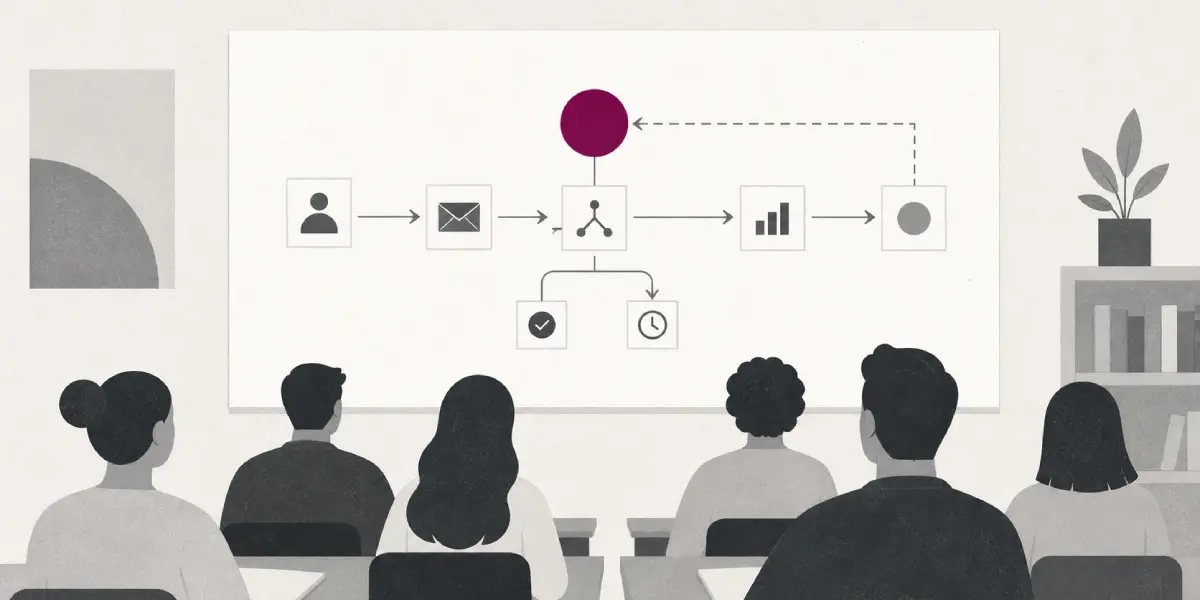
Then keep the architecture simple: trigger → audience → action → outcome. Connect the workflow to a metric, review performance regularly and only add complexity when the data gives you a reason to.
The platform should follow that strategy. Our guide to choosing a marketing automation platform covers the evaluation process, while 9 marketing automation platforms gives you options to compare once you know what the system actually needs to do.
You do not need more automation for the sake of it. You need a small number of well-designed workflows that respond to real customer behavior and improve the numbers that matter.
Frequently asked questions
How can marketing automation actually help your business grow?
Marketing automation can improve growth by making follow-up faster and more consistent across the customer lifecycle. Useful workflows include lead nurturing, qualification and routing, abandoned-cart recovery, onboarding, renewal reminders and win-back campaigns. The value comes from connecting each workflow to a measurable pipeline, revenue or retention outcome.
What are some practical examples of marketing automation I can use today?
Good starting examples include a welcome series, lead magnet follow-up, lead nurturing, lead scoring and sales handoff, cart or form abandonment, transactional updates, customer onboarding, replenishment reminders, win-back campaigns, review requests and referral flows. Choose one with a clear trigger and measurable outcome.
Is marketing automation useful for small businesses with limited budgets?
Yes. Small businesses can start with relatively simple workflows such as welcome emails, appointment reminders, lead follow-up, abandoned-cart messages or re-engagement campaigns. Start with the process that currently consumes the most manual time or loses the most opportunity, then expand once it is working reliably.
How do you measure if your marketing automation is working?
Measure the metric the workflow is designed to change. Engagement metrics such as clicks and responses help diagnose performance, but commercial measures such as qualified leads, conversion rate, recovered revenue, activation, repeat purchase rate, retention and customer lifetime value tell you whether the automation is creating business value.
What is the best way to start with marketing automation if you are new?
Choose one clear objective, identify the trigger and audience, define the action the workflow should take, and decide how success will be measured. Launch the simplest version first, review the data and customer response, then add branches, channels or personalization only where they improve the outcome.
Will marketing automation replace human marketers?
No. Automation can handle repeatable execution, routing, reminders and parts of personalization, but people still need to define the strategy, customer experience, messaging, rules and measurement. Human judgment is also essential when a customer situation falls outside the workflow.
What trends will shape the future of marketing automation?
Key trends include predictive scoring and next-best-action models, more dynamic personalization, conversational AI, stronger cross-channel orchestration and tighter integration between CRM, marketing and customer data. Privacy, consent and data governance will become more important as automation uses richer customer signals.
Marketing automation for beginners - build a strategy that actually works
Unlock your potential with our marketing automation strategy for beginners guide, designed to deliver real results and drive success.
7 tried and tested email marketing platforms for your small business
Check out 9 of the best email marketing platforms for small businesses in 2026, tailored for growth and engagement.
How to choose a marketing automation platform (without wasting money)
Find out how to choose a marketing automation platform wisely and effectively, ensuring you get the best value without overspending.