

By David Miguel on Dec 31, 2025

Most healthcare practices do not struggle with demand. They struggle with system flow. Enquiries arrive, but bookings leak. Patients attend once, but never return. Marketing spend increases, but revenue clarity decreases.
This stack solves that by defining a minimal but complete operating architecture for clinics, allied health providers, and private practices that want predictable patient acquisition, strong retention, and full visibility across the entire patient lifecycle.
1. CRM & patient management – Cliniko
Cliniko functions as the central operating system for a healthcare practice. It is not simply a scheduling tool. It is the platform that stores, governs, and structures every meaningful interaction between a patient and your clinic.
At a practical level, Cliniko manages patient records, appointment scheduling, practitioner availability, billing, and clinical notes. More importantly, it centralises patient lifecycle data in a way that supports both compliance and commercial decision-making. Every booking, missed appointment, completed treatment, recall reminder, and invoice becomes structured data rather than scattered information across emails, spreadsheets, and inboxes.
This centralisation is critical for growth. Marketing systems can generate enquiries, but only a healthcare-grade CRM can safely and reliably convert those enquiries into long-term patient relationships. Cliniko provides a compliant environment for storing personal and medical information while maintaining clean reporting on utilisation, revenue, and treatment trends.
Practices using Cliniko gain visibility over practitioner capacity, appointment lead times, recall performance, and patient retention. This allows growth planning to be based on real operational limits rather than guesswork.
Business impact
- Creates a single, compliant source of truth for all patient, appointment, and revenue data
- Reduces administrative labour through automation of reminders, billing, and recalls
- Improves appointment utilisation and practitioner capacity planning
- Enables structured recall and reactivation programs
- Supports audit, privacy, and compliance requirements without external systems
- Improves retention and lifetime patient value through consistent follow-up workflows
2. Website & conversion platform – Webflow
For most practices, the website is the first point of clinical trust and the primary booking channel. However, many healthcare websites are built on outdated platforms that are slow, insecure, and difficult to manage, which directly reduces search visibility and conversion rates.
Webflow provides a modern CMS that combines managed hosting, clean code, and flexible design with strong SEO foundations. It allows healthcare practices to build fast, secure websites that meet accessibility standards and support structured service and location pages without relying on fragile plugin ecosystems.
From a growth perspective, Webflow enables clinics to create pages specifically optimised for high-intent searches such as symptom queries, treatment-based searches, and “near me” local searches. These pages can be structured to integrate directly with online booking and intake workflows, reducing friction between discovery and appointment.
This transforms the website from a static brochure into a conversion platform that actively generates qualified bookings while remaining easy for internal teams to maintain.
Business impact
- Improves organic visibility for service- and location-based searches
- Increases booking conversion rates through faster page load speeds and clean UX
- Reduces ongoing maintenance costs by eliminating plugin dependency
- Enables rapid deployment of landing pages for new services and locations
- Lowers reliance on paid advertising by increasing inbound organic demand
- Improves accessibility compliance and trust signals for patients

3. Lead capture & patient onboarding – IntakeQ
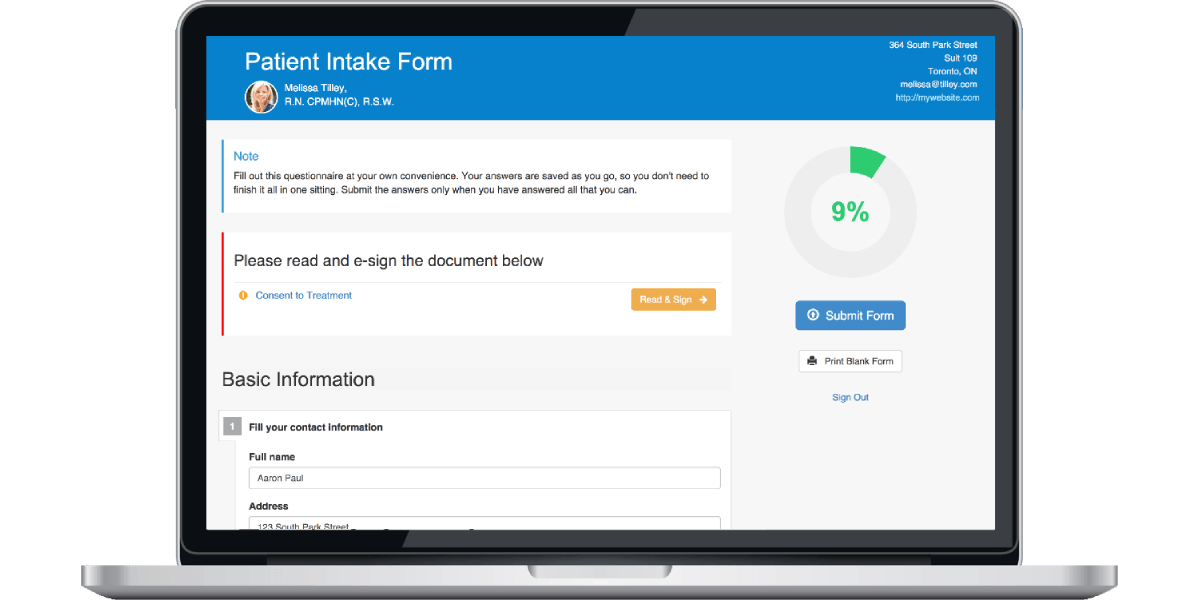
The period between booking and first appointment is one of the most common failure points in patient acquisition. Patients may forget appointments, fail to complete forms, or arrive unprepared, increasing administrative workload and reducing attendance rates.
IntakeQ solves this by automating patient onboarding. It delivers secure digital forms, consent documentation, questionnaires, and document uploads as part of a structured workflow. Patients receive these automatically after booking, ensuring they are properly prepared before arrival.
For the practice, IntakeQ significantly reduces front-desk workload and improves the accuracy of patient records by collecting structured data directly into Cliniko. This reduces manual data entry, prevents missing consent documentation, and improves the overall patient experience.
From a business perspective, IntakeQ improves appointment attendance, shortens time to first consultation, and supports compliance processes that are critical in healthcare environments.
Business impact
- Reduces appointment drop-off and no-show rates
- Shortens time between enquiry and first consultation
- Improves front-desk efficiency by automating paperwork and consent capture
- Improves data accuracy and reduces manual entry errors
- Supports privacy and consent compliance workflows
- Improves overall patient experience during onboarding
4. Marketing automation & patient reactivation – MailerLite
Healthcare growth does not rely solely on new patient acquisition. A significant proportion of revenue comes from patient retention, recalls, and reactivation of lapsed patients.
MailerLite provides a lightweight but powerful marketing automation platform that enables clinics to manage ongoing patient communication in a compliant and structured way. It supports automated appointment reminders, post-treatment follow-ups, care plan communications, and recall campaigns based on time since last visit or treatment type.
Practices can segment patients by service history, treatment plans, or engagement levels and deliver relevant communication automatically rather than relying on manual follow-up processes. This ensures continuity of care while increasing lifetime patient value.
MailerLite also supports educational content and seasonal campaigns, helping practices maintain ongoing relationships with their patient base rather than starting from zero with each marketing push.
Business impact
- Increases lifetime patient value through recall and reactivation campaigns
- Improves appointment attendance and reduces no-shows
- Fills practitioner availability gaps
- Enables scalable follow-up workflows without increasing admin staff
- Supports ongoing patient education and engagement
- Stabilises monthly revenue through consistent retention activity
5. Visibility & local patient acquisition – Google Business Profile and local SEO
For most healthcare practices, local search is the highest-intent acquisition channel. Patients searching for symptoms, treatments, and nearby providers are actively seeking care, making these searches significantly more valuable than general brand awareness traffic.
Google Business Profile allows practices to appear in map results, local packs, and branded searches. Combined with local SEO, it enables clinics to rank for location-based service queries and symptom-driven searches that generate consistent inbound enquiries.
Local SEO involves optimising service and location pages, building consistent business citations, acquiring reviews, and generating authoritative local backlinks. Over time, this compounds into stronger local visibility and increased patient trust.
This channel becomes a predictable source of inbound bookings that reduces reliance on paid advertising while delivering consistently high conversion rates.
Business impact
- Increases inbound enquiries from high-intent local searches
- Improves booking conversion rates before website interaction
- Reduces reliance on paid advertising
- Builds long-term local authority and review equity
- Improves trust and credibility through public review visibility
- Creates compounding, long-term patient demand
6. Reporting & Revenue Visibility – GA4 and Looker Studio
Most practices lack visibility into which marketing activities actually produce bookings and revenue. Without attribution, budget decisions are based on assumptions rather than performance.
GA4 tracks how patients arrive at the website, what content they engage with, and where they convert. Looker Studio consolidates this data into dashboards that provide channel-level attribution, conversion rates, and booking trends.
This reporting layer enables practices to understand which services, locations, and marketing channels generate the highest return, allowing budgets to be allocated more efficiently and growth strategies to be data-driven rather than speculative.
Over time, this transforms marketing from an expense into a measurable investment with predictable outcomes.
Business impact
- Provides channel-level attribution for bookings and enquiries
- Improves marketing budget allocation decisions
- Identifies high-performing services and locations
- Reduces wasted marketing spend
- Enables predictable growth forecasting
- Turns marketing into a measurable, optimisable revenue channel
Final thoughts

Most healthcare practices don’t struggle because they lack effort. They struggle because their systems were never designed to work together as a complete growth engine. Over time, tools get added to solve isolated problems, and the result is a stack that feels busy but delivers inconsistent outcomes.
The purpose of this stack is to simplify. Each platform has a defined role in how patients find you, book, attend, return, and generate revenue. When those roles are clear, teams work more efficiently, patients experience less friction, and growth becomes predictable rather than reactive.
If your current setup feels complex, fragile, or hard to measure, it’s usually a sign that the architecture needs to be reset rather than expanded. Starting with a minimal, well-integrated stack gives your practice a stable foundation that can grow with you without increasing overhead or administrative pressure.
Getting the right systems in place does more than improve marketing. It improves patient experience, team efficiency, and your ability to make confident business decisions based on real performance rather than assumptions.
Frequently Asked Questions
What is healthcare marketing software?
Healthcare marketing software is the set of tools clinics and private practices use to attract new patients, manage enquiries, improve patient communication, and measure marketing performance. It typically includes your website, booking or enquiry capture, email or SMS messaging, analytics, and reporting.
What’s different about marketing for clinics compared to other industries?
Healthcare marketing is built on trust, privacy, and clarity. Patients need reassurance, accurate information, and an easy path to booking. Clinics also need to consider compliance, consent, and how patient data is handled across tools and platforms.
What tools do clinics need most in a modern marketing stack?
Most clinics benefit from a practical stack that includes: a fast, mobile-friendly website, strong local SEO tools, a lead capture system (forms and call tracking), a booking or practice management connection, email and SMS messaging, and analytics that can track calls, forms, and appointment requests.
Does a clinic need a CRM?
Not always, but many clinics benefit from one. A CRM helps manage enquiries, follow-ups, referrals, and reactivation campaigns, especially if multiple staff handle patient enquiries. If you already use a practice management system, a CRM is most useful when it fills gaps in marketing follow-up and reporting.
What is the most important marketing channel for clinics?
For most clinics and private practices, local search is the highest-intent channel. This includes Google Business Profile optimisation, local SEO, reviews, and location pages. Paid search can add predictable demand, especially for high-value services, but it works best when tracking and landing pages are strong.
How can clinics increase bookings from their website?
Start by reducing friction: clear service pages, strong calls to action, click-to-call on mobile, simple enquiry forms, and visible booking pathways. Then improve conversion with trust signals like practitioner bios, reviews, accreditations, clear pricing guidance where appropriate, and FAQs that address patient concerns.
Is email or SMS better for patient communications?
They do different jobs. SMS is best for time-sensitive messages like appointment reminders or short updates, while email is better for education, pre-visit instructions, post-visit care guidance, and nurturing patients toward a service. The best approach is using both, with clear consent controls.
How should clinics handle privacy and consent in marketing tools?
Clinics should use tools that support consent-based communication and protect patient information. Collect consent clearly, store data securely, restrict access by role, and avoid putting sensitive health details into marketing platforms. When in doubt, keep marketing data focused on enquiries and preferences rather than clinical records.
What metrics matter most for healthcare marketing?
The most useful metrics are the ones tied to patient acquisition: calls, form submissions, booking requests, cost per lead, conversion rate from enquiry to appointment, and appointment volume by service line. Where possible, track outcomes by location and campaign to understand what drives demand.
How can clinics track calls and bookings accurately?
Use call tracking for marketing numbers, track form submissions and booking button clicks, and connect your website analytics to ad platforms. If your booking system allows it, use tagged links so you can see where appointment requests originated. The aim is one clear view of which channels generate real patients.
What are common mistakes clinics make when choosing marketing software?
Common mistakes include picking tools that don’t integrate, relying on vanity metrics (traffic instead of bookings), not tracking calls, over-automating patient communication, and using systems that make consent and privacy messy. A lean stack with clean tracking beats a complex stack that no one trusts.
Can small practices run effective marketing without a big budget?
Yes. Many practices can grow with a strong local foundation which includes a high-performing website, local SEO, reviews, clear service pages, and basic tracking. Add paid search only when the basics are working and you can measure bookings reliably.

The essential marketing technology stack for professional services
The best marketing software stack for professional services firms. Generate qualified leads, automate follow-up and track pipeline and revenue.

AI Governance for Business: A Practical Framework
Explore our complete guide on AI governance for business in 2026, offering unique insights and practical strategies for success.

Maximize your reach with effective email blast programs
The top email blast programs that improve engagement and drive results, tailored for businesses of all sizes.